Replication Speed Is the Real Bottleneck
Lately I have been looking for the next batch of high-alpha stocks capable of breaking the market's old valuation model. The starting point was embarrassingly ordinary: who comes after GEV? Who comes after SK hynix? The candidate list was long. I reached the end and noticed one name was missing: SpaceX.
SpaceX did not necessarily belong on the list. But if a method cannot explain why it was excluded, a longer list only gives me more unexplained answers. I did not rush to add SpaceX back. I asked one question: why was it missing?
SpaceX has a way of making people forget that they are investing. The moment it comes up, the conversation drifts toward Mars, the stars, and a multi-planetary civilization. Sentiment is worthless to capital. Strip away the mission and SpaceX leaves behind a hard cost curve: launch cadence, reuse, and dollars per kilogram. The economics depend on whether something once done only once can be repeated a hundred times, reliably, cheaply, and quickly.
A stock list cannot give you alpha
I started by looking for stocks. Only later did I realize that the starting point itself was wrong.
“Who is the next GEV?” and “Who is the next SK hynix?” will always produce a list. A list can only summarize what has already happened. By the time everyone knows that GPUs, gas turbines, and memory are bottlenecks, the fattest part of the re-rating is usually over. The fundamentals may remain excellent while the alpha moves elsewhere.
The useful thing is not the answer. It is the method that keeps producing answers.
Serenity, the Bottleneck Hunter already covered how the white-haired investor finds bottlenecks. I will not retell that story here. That essay answered one question: how do you locate the narrowest node in an industry chain?
This essay asks a more basic one: what actually qualifies as a bottleneck?
We tend to treat “core technology” as the answer. Whoever owns the chip, the drug molecule, the reactor, or the new material owns the bottleneck. That is only half right. Core technology determines whether something can go from zero to one. Once an industry takes off, the winner is determined by how quickly one unit of delivery capacity can be replicated into ten.
The real bottleneck is often not whether a technology works, but whether supply can replicate tenfold, fast enough, when demand suddenly grows tenfold.
The first Falcon 9 landing mattered. What changed launch economics was the prospect of high-frequency reuse—whether the second, fifth, and hundredth flight could move down the learning curve.
A technical breakthrough is the admission ticket. Replication determines how far an industry can go.
The bottleneck lives between two clocks
To understand replication, I compare two clocks.
One measures how soon demand arrives. The other measures how long supply takes to replicate:
Replication Gap = Time to replicate supply − Time for demand to arrive
If demand arrives in eighteen months and supply needs forty-eight months to catch up, the thirty months in between are the scarcity window. Orders, backlog, price increases, and excess returns tend to pile into that gap.
This definition is more useful than “technical moat” because it puts seemingly unrelated industries into the same framework.
A drug that works in a clinical trial is zero to one. Scaling GMP lines, fill-finish, quality control, cold chain, and qualified staff together is one to ten. Patients cannot take the dose sitting in a lab.
One SMR connected to the grid is zero to one. Building ten reactors in a row, each faster and cheaper than the last, is one to ten. Without repeatability, it remains an expensive and beautiful technology.
EGS is no different. One productive well does not prove that the fiftieth can arrive on schedule and on budget. Even software cannot escape the rule. Code can be copied at nearly zero cost; databases, compute, security review, customer support, and organizational response cannot.
I therefore separate an industrial bottleneck from investable alpha:
Bottleneck Strength ∝ Demand Shock × Supply Inelasticity × Replication Gap
Alpha = Bottleneck Strength × Mispricing
A scarce node does not automatically offer alpha. GEV, VRT, and mainstream memory can remain excellent bottlenecks after the market has priced them as such. The odds have changed. The better hunting ground is the next bottleneck their expansion is creating but the market has not yet noticed.
GPUs proved that solving a bottleneck creates another
AI is the cleanest stress test of this framework.
At first, everyone lacked GPUs. Yet a GPU is not delivered when it leaves the fab. It still needs HBM, advanced packaging, substrates, server racks, switches, optical interconnect, power, and cooling. If one item falls behind, the finished GPU becomes expensive inventory.
Vera Rubin production requires coordination across more than 350 facilities in 30 countries and hundreds of supply-chain partners. A GPU ramp is really an entire industrial system ramping together. NVIDIA's own disclosure makes that point plainly.
Then something interesting happened.
More GPU supply allowed more clusters to come online, and the bottleneck spread along the dependency graph. It hit HBM and packaging first, then networking, power, cooling, and storage. NVIDIA's Data Center networking revenue rose 199% year over year in the first quarter of fiscal 2027. That is what pressure migrating from compute into interconnect looks like in a financial statement. NVIDIA FY2027 Q1
The GPU bottleneck did not disappear. The throughput released by GPU expansion created the next set of bottlenecks.
GEV proved that mature technology can still replicate slowly
Gas turbines make the point even better because the technology is not new.
In the second quarter of 2026, GE Vernova disclosed that its gas-turbine equipment backlog and slot reservations had grown to 116GW. The company expected its annualized gas-turbine output rate to reach only 20GW in the third quarter of 2026. Raising annual output to 30GW will take until 2030. GE Vernova Q2 2026
GEV does not lack theory, orders, or the knowledge required to build a turbine. It lacks the time needed to replicate large forgings and castings, specialty alloys, coatings, compressor parts, assembly workers, test stands, and supplier quality systems together.
As AI data centers move from megawatts to gigawatts, customers are not buying turbine technology. They are buying a dependable delivery slot. Demand can double within one budget cycle. Industrial capacity takes years to climb. Mature technology makes this mismatch easier to overlook.
GEV, however, is already a red light. The next question is not simply whether to chase GEV. It is: if GEV had to expand tenfold, what would it run out of first?
Forgings, alloys, coatings, compressor components, and skilled labor are small, unglamorous markets. They may also be the yellow nodes a red node is creating.
Storage proved that capacity is not delivery
Storage looks easy to replicate. Make more NAND bits. What is so difficult about that?
A hyperscaler does not buy a pile of NAND. It buys an enterprise SSD that remains stable under a real workload. That requires a controller handling FTL, ECC, wear leveling, garbage collection, and power-loss protection. It requires firmware, PCIe/NVMe, and lengthy qualification by server OEMs and hyperscalers.
Micron expects data-center DRAM and NAND bit shipments in 2026 to double from two years earlier. Agentic AI is also extending infrastructure beyond accelerator racks into storage racks that hold context. Micron Q3 2026 materials
The bottleneck keeps moving. Tight NAND supply gives memory manufacturers pricing power. Once wafer supply rises, pressure can migrate into enterprise SSDs, controllers, firmware, power, and qualification capacity.
Terabytes are a specification. Going online reliably and on time is supply.
Optical modules proved that bandwidth has a replication gap
More GPUs exchange more data. Compute per GPU rises with each generation, while traffic inside the cluster may rise even faster. Once compute expands, networking moves from supporting actor to system limit.
800G works, and 1.6T optical DSPs and transceivers have entered mass production. That does not mean optical interconnect can replicate tenfold overnight.
Behind one optical module sit DSPs, lasers, photodiodes, silicon photonics, packaging, connectors, fiber, and testing. They come from different processes and suppliers, yet all must pass inside the same small box. Module volume pushes pressure into lasers, DSPs, SiPh, packaging, and test. Faster networks then allow clusters to add more GPUs.
At this point, a linear supply chain no longer explains what is happening.
GPUs, gas turbines, enterprise SSDs, and optical modules are not four isolated examples. They are lights coming on across the same network.
The Bottleneck Migration Network
In the real world, a bottleneck does not move from A to B and then B to C. Congestion propagates through a network.
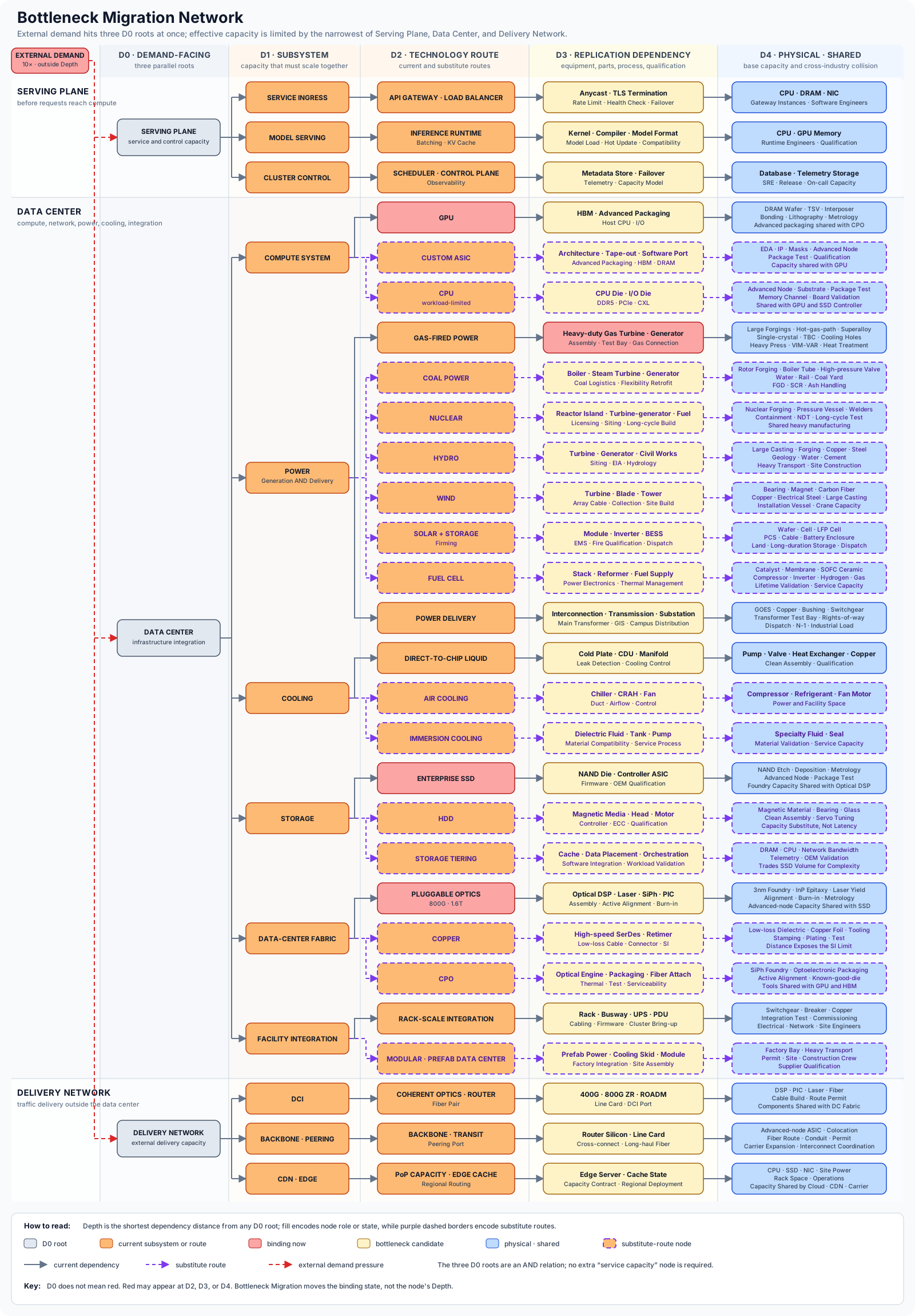
But the map cannot start with the GPU. A card does not accept a user request by itself, and a data center does not operate in a vacuum. External demand presses on three capacity planes at once: the Serving Plane, Data Center, and Delivery Network. They are not three serial stops, and there is no need to invent another node called “serviceable AI capacity.” They are parallel roots. The narrowest one caps what the system can actually deliver.
The Serving Plane turns requests into workloads. The Data Center integrates compute, power, cooling, storage, fabric, and facility infrastructure into clusters that can go live. The Delivery Network uses DCI, backbone, transit, peering, and CDN or edge capacity to bring traffic in and carry results out. More GPU supply becomes usable service capacity only when all three systems scale with it.
That is why GPU expansion raises demand for HBM, packaging, networking, storage, and power at the same time. More turbine and grid capacity lets additional GPUs come online. Those GPUs push optics and storage back toward the red line. Every solved node releases flow that collides with an adjacent node.
Stopping at forgings, controllers, or DSPs is still too coarse. Those are product categories, not capacity that can be tracked. A node has to be broken down into equipment, materials, process steps, or qualification until lead time, utilization, yield, and expansion plans become measurable.
To draw that migration clearly, the network needs another coordinate: Bottleneck Depth.
It is not technical difficulty or the number of tiers in a conventional supply chain. It measures how far a node sits from the three demand-facing roots above. The external demand shock itself is outside Depth:
Bottleneck Depth(node) = Shortest dependency path from any D0 root to node
D0 contains the Serving Plane, Data Center, and Delivery Network. D1 contains the subsystems that must scale with each root. D2 contains current and substitute technology routes such as GPUs, gas-fired power, SSDs, and optical modules. D3 contains the equipment, parts, processes, and qualification required to replicate those routes. D4 reaches the physical capacity and cross-industry constraints underneath them. The deeper the node, the less familiar the market usually is with it, the harder its capacity is to measure, and the more likely it has not been priced in.
Depth counts hops from any D0 root; it does not prescribe an edge type. Solid lines show current dependencies. Purple dashed lines show substitute routes not yet adopted. In Power, gas, coal, nuclear, and the other generation routes can substitute for one another; power delivery is a separate path that must be satisfied at the same time. A substitute route cannot stop at its name. It still has to be expanded through D3 and D4.
Depth and bottleneck status are separate dimensions. D0 marks a topological root; it does not mean red. Red marks a binding constraint and may appear at D2, D3, or even D4. Yellow marks a candidate that has not yet turned red. A purple dashed border marks a route that has not yet been adopted. A node can therefore be both yellow and purple-dashed.
D0 and Depth do not need to be renumbered when the red light moves. What migrates is the binding state. Once GPU supply loosens, the red light may move into HBM, or jump into power, cooling, or the Delivery Network. The coordinates stay put. The narrowest node changes.
A node turning red is where the research begins. Every new order required for its expansion pushes pressure into upstream suppliers and other industries competing for the same materials, equipment, and capacity.
In the Bottleneck Hunter framework, we follow demand until we find the narrowest node. With a Bottleneck Migration Network, the question changes: once that node turns red, which adjacent node does it push from green to yellow? Which supplier has the largest Replication Gap when the red node expands? Which node is being pulled at once by AI, the grid, defense, nuclear power, or autos?
This network applies not only to AI. Replace the GPU with a new drug and the nodes become active ingredients, bioreactors, fill-finish, cold chain, and approval. Replace it with an SMR and the nodes become nuclear-grade forgings, fuel, licensing, welders, and site construction. The names change. The propagation does not.
The data center is AI's largest bottleneck
Shrink the map until only its structure remains. The Serving Plane, Data Center, and Delivery Network are still three roots, but D1 through D4 do not spread evenly. AI may look as if it lives in the cloud; replication happens on the ground. Cards must go into racks, power must reach them, heat must leave, and storage and networks must connect before a service can go live.
For physical delivery, the data center is the center of the AI bottleneck. Capacity added to the Serving Plane and Delivery Network still has to be absorbed by compute, storage, networking, power, cooling, and facility integration inside the data center.
Keep moving down the graph and only two paths remain.
The first is power. Gas, coal, nuclear, and renewables sit at the generation layer. Grid connections, transmission, substations, transformers, switchgear, UPS, PDU, cooling, and field construction must scale with the data center. Generation routes can substitute for one another. Power delivery cannot be skipped. The Replication Gap usually hides in permits, heavy-equipment capacity, grid construction, and project delivery cycles.
The second is semiconductors. In this network, they look more like a general means of production. Compute descends into GPUs, CPUs, HBM, and advanced packaging. Storage descends into NAND, controllers, and qualification. Networking descends into DSPs, SiPh, PICs, ASICs, and optical chips. The servers in the Serving Plane and the routers and edge servers in the Delivery Network eventually depend on logic, memory, analog, power, and sensors as well.
The power path also bends back into semiconductors. Generation equipment has relatively little dependence on advanced nodes, but the modern grid, UPS, storage, cooling, motor drives, protection, and sensing all use power semiconductors, analog chips, MCUs, and sensors. When AI, the grid, BESS, solar, EVs, and robotics expand together, they may compete for the same unglamorous chips and manufacturing capacity.
Power and semiconductors are not two independent parallel lines. Power is an industrial system that is hard to replicate quickly. Semiconductors run through compute, storage, networking, cooling, and power control. The two lines meet again in power electronics and control systems.
The market sees GPUs, HBM, and advanced nodes first, so their Price-in Scores tend to be high. The Bottleneck Migration Network points to a different class of semiconductor: a cheap part in the BOM that can block delivery of an expensive machine. Analog, MCUs, power management, power semiconductors, sensors, industrial connectivity, and motor control may never be marketed as AI chips, yet they can absorb demand from data centers, grids, storage, cooling, and automation at the same time.
The research cannot stop at “buy semiconductors.” If semiconductor demand grows tenfold, can wafers, equipment, materials, advanced packaging, and test capacity scale with it? Which step is slowest: etch, deposition, metrology, bonding, specialty wafers, or specialty gases? The next red light may not be a chip. It may be a manufacturing step that every chip must pass through and only a few suppliers can deliver.
After GPUs, GEV, enterprise SSDs, or optical modules turn red, I first ask whether the demand they release will hit power or semiconductors. If it is power, I follow generation, delivery, cooling, and facility integration while checking their semiconductor dependencies. If it is semiconductors, I continue from the chip into equipment, materials, packaging, and test. Then I compare supply elasticity, Replication Gap, and Price-in Score.
Along the current path, the next alpha is not hidden inside the labels “power stock” or “semiconductor stock.” It sits at the layer on these two paths with the slowest replication, the highest criticality, and the lowest market recognition.
That leaves a larger question than how to replicate power and semiconductors faster: can the whole terrestrial path be replaced instead of optimized?
SpaceX does not optimize the data center. It replaces it
When Elon Musk says AI could become the largest source of SpaceX's value, the claim should not be read as a bet on models or GPUs. SpaceX is targeting the data center.
The conventional response is to improve the terrestrial path one part at a time: build more generation, expand the grid, lower PUE, and shorten interconnection and construction schedules. Yet the same path still requires generation, grid delivery, distribution, cooling, facilities, and networking to replicate together. One slow component can still hold up the entire data center.
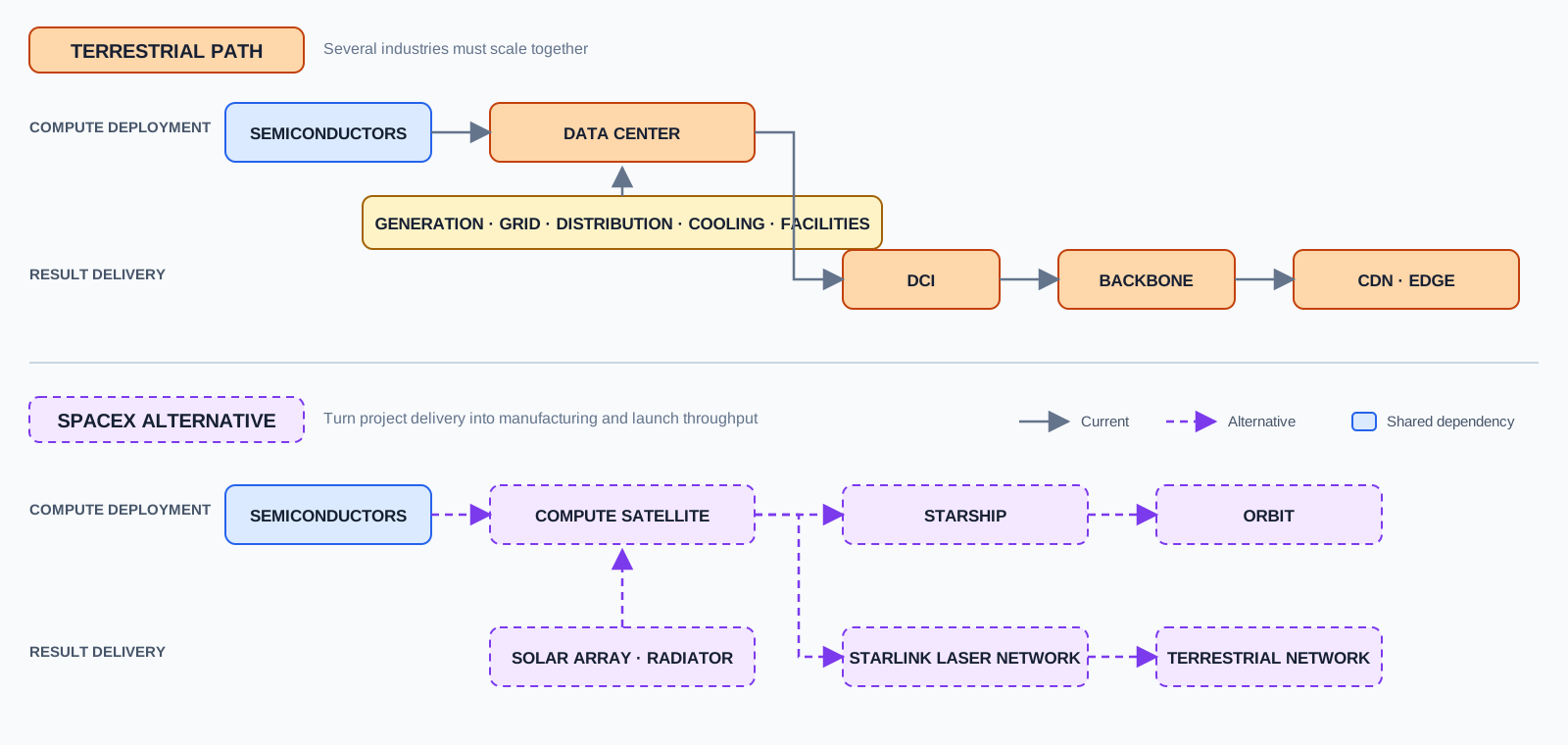
SpaceX chose a different answer: replace the terrestrial data center as a whole. Solar arrays replace generation and the grid. Radiative cooling replaces conventional cooling. Gigasat Factory and Starship replace land, permits, and civil construction. The Starlink laser network reconnects the results to Earth. Semiconductors and the final terrestrial network remain, but the hardest path between them, data-center deployment, is replaced as one system.
SpaceX therefore does not belong in a single D2 or D3 box. It is not an optimization node on the current path. It is a complete alternative that branches from the Data Center and reconnects to the Delivery Network through Starlink:
SpaceX's published StarMind architecture puts solar power, the compute payload, thermal radiation, Starship deployment, and the Starlink laser network into one system:
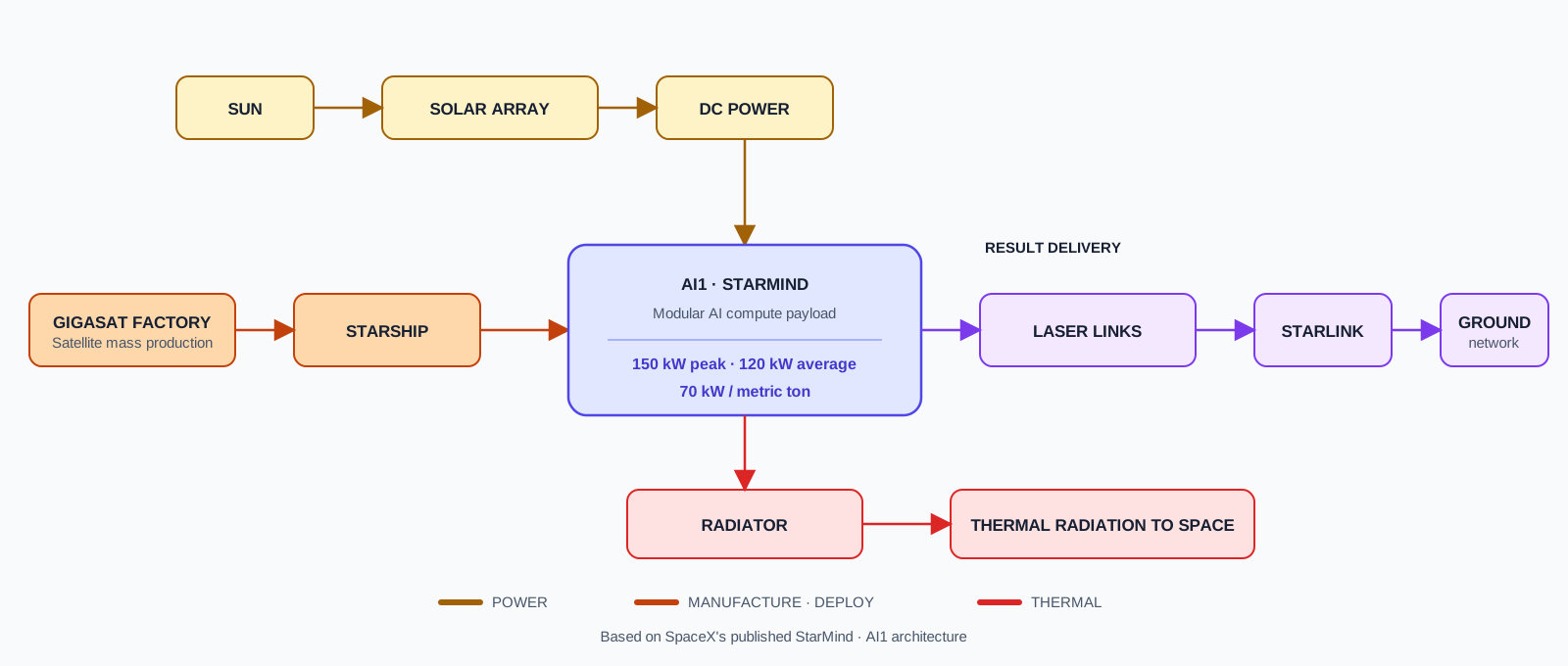
That substitutes bottlenecks rather than eliminating them. Once the grid, transformers, and construction no longer gate deployment, new red lights appear in satellite manufacturing, solar arrays, radiator mass, radiation tolerance, launch cadence, and the laser network. Running a computer in space is zero to one. Manufacturing, launching, and networking thousands of them is one to ten.
Dollars per megawatt-hour is therefore not the most useful metric for this route. A more direct one is:
Useful compute per kilogram to orbit × kilograms launched per year = orbital compute added per year
StarMind must raise the first term, Starship the second, and Starlink must reconnect that compute to the Delivery Network. Remove any one of them and orbital compute remains a working satellite rather than replicable AI infrastructure.
The wager is that satellite manufacturing throughput and launch throughput can scale faster than a construction project spread across a dozen industries. If they do, SpaceX could become a machine for manufacturing compute capacity. If radiators, launch cadence, or satellite production fall behind, the red light has merely moved from the ground into orbit.
The crossover: when OpenAI moves from 10GW toward 30 to 50GW
OpenAI is the best available stress test for these two routes. In April 2026, OpenAI said Stargate had passed its initial 10GW planning milestone and that it was evaluating sites beyond 10GW. OpenAI's published update shows that 10GW is no longer a distant scenario, although multiple terrestrial sites and dedicated energy projects can still deliver it. At continuous load, 10GW consumes 87.6TWh per year. If one platform moves next to 30 or 50GW, annual electricity use rises to 263 or 438TWh. The latter is already in the same range as the 415TWh consumed by all data centers worldwide in 2024. The IEA expects the global total to reach only about 945TWh by 2030.
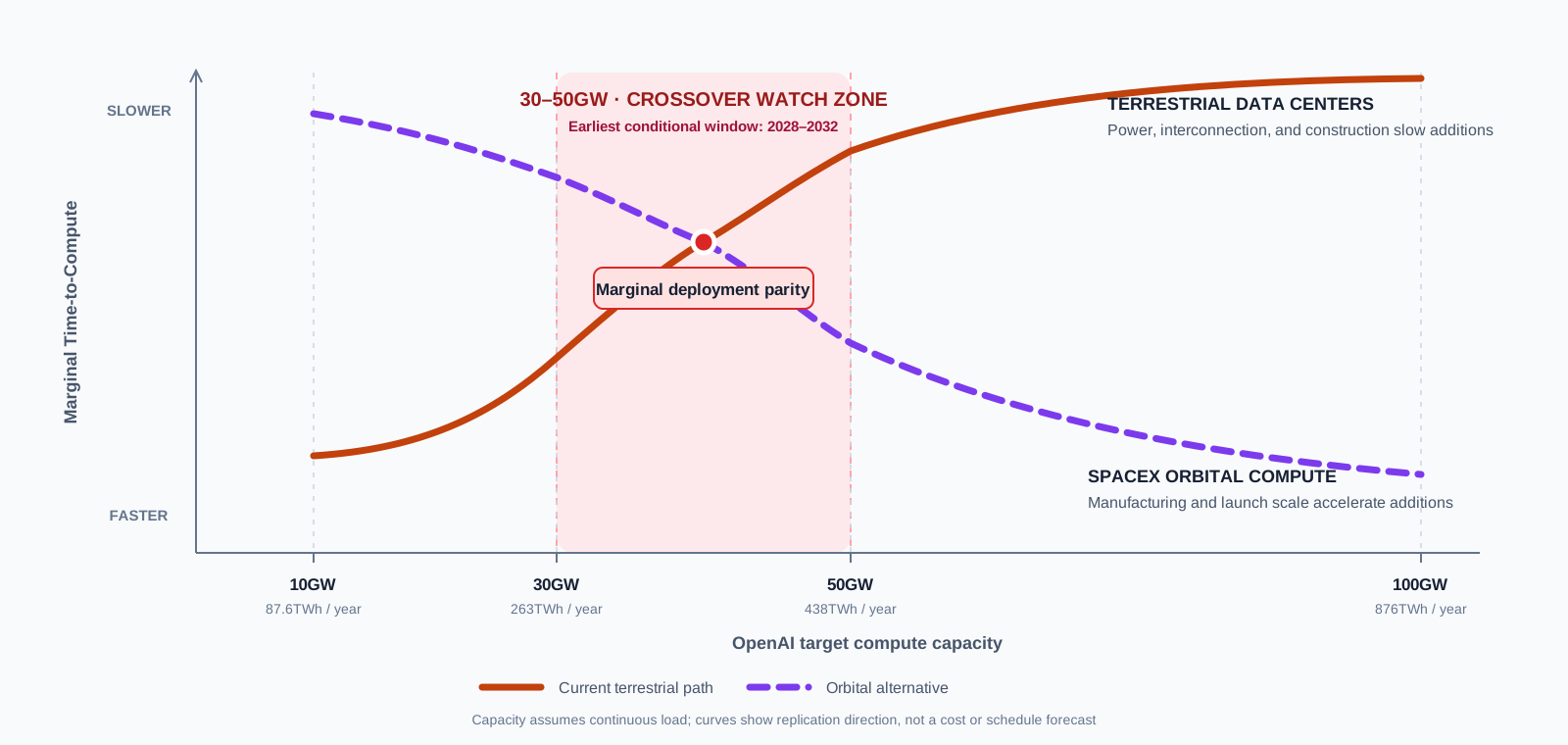
The crossover is therefore not a fixed year, nor the moment orbital electricity suddenly becomes cheaper than terrestrial electricity. It requires a more specific condition: OpenAI's next block of desired capacity is moving toward 30 to 50GW, while the annual delivery of power-ready terrestrial capacity persistently falls behind GPU and ASIC supply. Only then does the marginal Time-to-Compute of the orbital route have a chance to catch the terrestrial route. Based on the demand path disclosed so far, I would watch 2028 to 2032 as the earliest window. At 50 to 100GW, orbital compute could shift from a long-dated option into a strategic one. Faster model-efficiency gains or faster replication of deployable terrestrial power would push the crossover farther out, perhaps indefinitely.
SpaceX was missing from the opening list because that list looked for the next bottleneck node on the current path: GEV maps to gas turbines, SK hynix to HBM. SpaceX is not the next node. Its bet is that the existing data-center path itself replicates too slowly.
By connecting StarMind, Gigasat Factory, Starship, and Starlink, SpaceX changes the unit of data-center replication. A site-specific project that needs permits, construction, and grid interconnection becomes a product that can be manufactured, launched continuously, and networked automatically. That Bottleneck Substitution Path ultimately exists to replicate data centers faster.
Technology determines whether orbital data centers work. Replication determines whether their capacity can scale tenfold fast enough.
- Blog Link: https://johnsonlee.io/2026/08/18/the-real-bottleneck-is-replication.en/
- Copyright Declaration: 著作权归作者所有。商业转载请联系作者获得授权,非商业转载请注明出处。